$650 Later: Building a Dashboard to See Where the Tokens Go
I spent $580 in three days and didn't notice.
February 7th through 9th. Deep in a coding sprint, multiple projects running, OpenClaw burning through Opus 4.6 calls like they were free. They were not free.
OpenClaw logs every LLM completion to a JSONL file. Every call, every token count, every cost. The data was right there the whole time. But nobody opens a 5,000-line log file and goes "ah yes, I see the spending pattern."
So I built a dashboard.
The Problem
OpenClaw has a built-in usage view. It exists. It also showed $0 for most of my historical data because the cost tracking config was wrong for the first week. Old records had no cost data. No backfill mechanism. Technically working. Practically useless.
I could have tried to fix the existing tracking. But you can't patch bad data with a better UI. I needed to start fresh.
Why Convex
The plan: read the JSONL logs, put them in a database, build charts on top. The interesting decision was which database.
I went with Convex. Two reasons.
Real-time queries come free. Convex uses WebSocket subscriptions under the hood. New data lands in the database, every connected dashboard updates instantly. No polling. No refresh button. No extra code.
The schema is just TypeScript. No SQL migrations. No ORMs. No type-safety hacks. Define tables, add indexes, done.
Three tables. That's the whole backend:
// convex/schema.ts
completions: defineTable({
  messageId: v.string(),
  timestamp: v.number(),
  agent: v.string(),
  model: v.string(),
  inputTokens: v.number(),
  outputTokens: v.number(),
  cacheRead: v.number(),
  cacheWrite: v.number(),
  costTotal: v.float64(),
})
  .index("by_timestamp", ["timestamp"])
  .index("by_model_timestamp", ["model", "timestamp"])
  .index("by_agent_timestamp", ["agent", "timestamp"]),

dailyStats: defineTable({
  date: v.string(),
  agent: v.string(),
  model: v.string(),
  totalCost: v.float64(),
  totalTokens: v.number(),
  messageCount: v.number(),
}).index("by_date", ["date"]),

ingestionState: defineTable({
  lastProcessedLine: v.number(),
})
completions stores every raw record. dailyStats stores pre-aggregated totals by date, agent, and model. ingestionState tracks offset so we only process new lines.
Why pre-aggregate? Because querying 4,834 raw records on every page load is slow. The dailyStats table has ~100 rows for a month. Dashboard loads in under 500ms.
The Ingest Pipeline
The ingest script reads the JSONL file, checks the last processed line from Convex, parses new records, and batch-inserts them. 50 records per batch.
// scripts/usage-ledger.ts (simplified)
const lines = readFileSync(LEDGER_PATH, "utf-8").split("\n");
const state = await ctx.query(api.ingestionState.get);
const startLine = state?.lastProcessedLine ?? 0;

const newRecords = lines.slice(startLine)
  .filter(Boolean)
  .map(line => JSON.parse(line));

for (let i = 0; i < newRecords.length; i += 50) {
  const batch = newRecords.slice(i, i + 50);
  await ctx.mutation(api.completions.batchInsert, { records: batch });
}

await ctx.mutation(api.ingestionState.update, {
  lastProcessedLine: lines.length
});
First run ingests everything. Every run after picks up the delta. The offset tracking means no duplicates, no reprocessing.
That's it. 176 lines of TypeScript.
OpenClaw Monitoring Itself
Here's the part that makes me smile. The hourly cron job that runs the ingest script? It runs on OpenClaw.
openclaw cron add \
  --name "Observatory Ingest" \
  --every "1h" \
  --command "cd ~/Projects/OpenClaw-Projects/openclaw-usage-dashboard && bun run scripts/usage-ledger.ts"
OpenClaw tracks its own spending. The thing generating the API costs is the same thing measuring them. Every hour, it wakes up, reads its own logs, pushes the data to Convex, and goes back to sleep.
Recursive accountability.
The Tremor Disaster
I started the dashboard with Tremor. React component library built for dashboards. Pre-built charts, Tailwind-native, built on Recharts. Sounded perfect.
It was not perfect.
Dark theme fights. Tremor's internal styling overrides Tailwind classes. Set text-white, chart labels render gray. CSS specificity battles on every component.
Custom colors ignored. Tremor has its own palette. Pass a hex code via props and it quietly uses its own colors instead. No error. No warning. Just wrong.
Tracker component broken. The activity heatmap rendered completely empty. No errors in console. No data. Blank rectangle. Spent an hour debugging before giving up.
So I ripped it all out. Every Tremor import, gone.
Here's the thing: Tremor is built on Recharts. It's an abstraction over an abstraction. When the higher abstraction fights you, drop down one level. Recharts gives you <AreaChart>, <Tooltip>, <XAxis> as composable pieces. Full control. No fighting.
Lesson: choose libraries one level lower than you think you need.
The Observatory Design
I wanted a command center. Not another white admin panel with oversized cards and breathing room.
True black background. #0a0a0a. Not zinc-950. Actual black.
Bento grid layout. Cards have different sizes based on importance. Total Cost gets a hero card spanning two columns. Cache metrics get a tall panel. Model comparison gets a wide table. Visual hierarchy through size, not color.
Typography matters. JetBrains Mono for all numbers and data. Makes everything scannable at a glance. Geist Sans for headers and body. High contrast — pure white on black.
No glassmorphism. The early designs had translucent backgrounds, backdrop blur, the works. Looked cool in mockups. Performed terribly in the browser and made data harder to read. Replaced with subtle borders (border-white/[0.06]) on dark cards. Cleaner. Faster. More readable.
On mobile, bento grid collapses to a single column. Tables become vertical card stacks. Every chart fills full width.
The Numbers
Real data. No inflation. As of February 10, 2026.
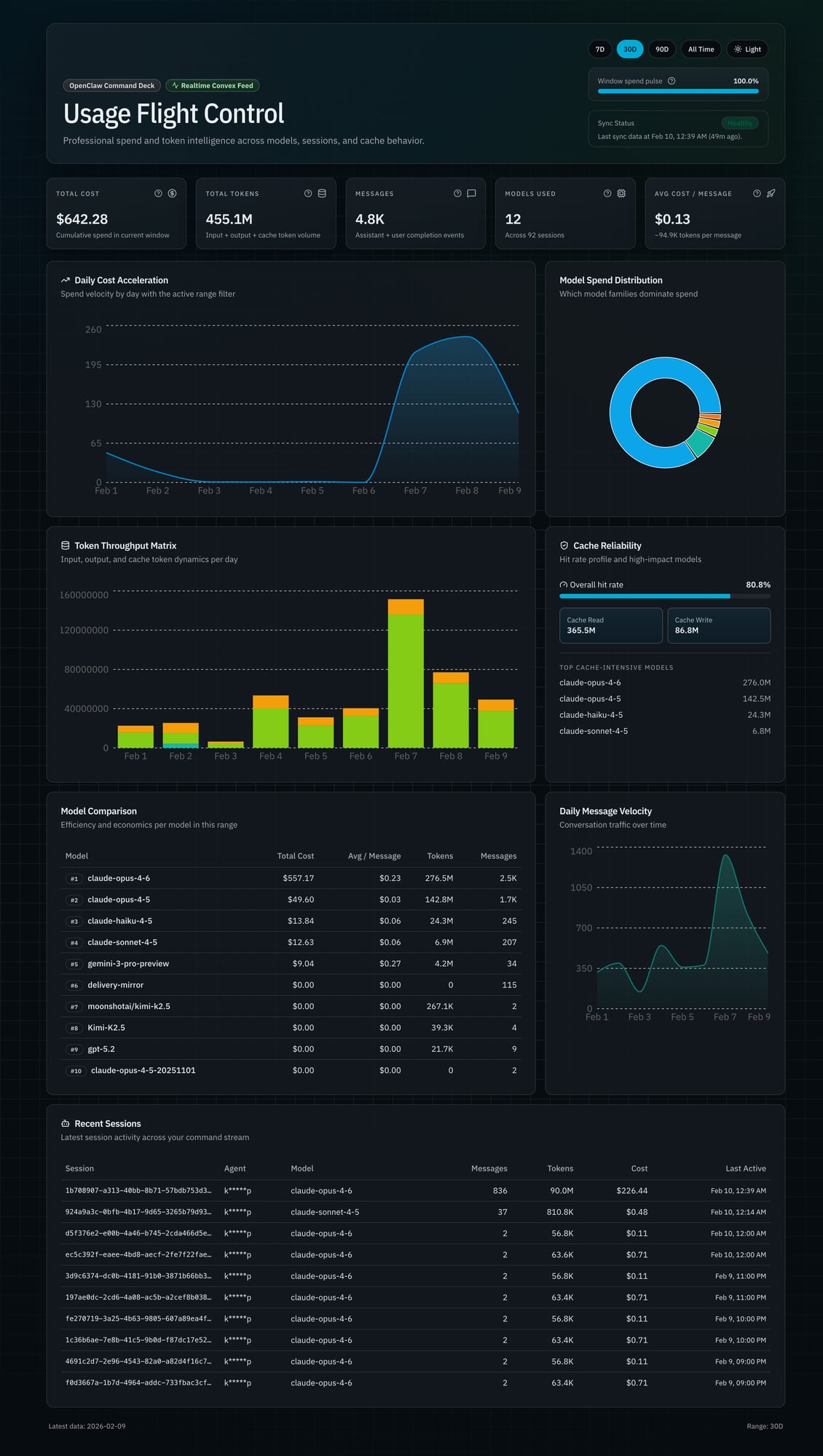
457.9 million tokens. 4,834 API calls. $649.59 total cost. 12 models across 92 sessions.
The model breakdown tells the real story:
| Model | Cost | Share |
|---|---|---|
| Claude Opus 4.6 | $564.24 | 86.9% |
| Claude Opus 4.5 | $49.60 | 7.6% |
| Claude Haiku 4.5 | $13.89 | 2.1% |
| Claude Sonnet 4.5 | $12.82 | 2.0% |
| Gemini 3 Pro | $9.04 | 1.4% |
87% of all spend is one model. Opus 4.6 at $15 per million input tokens and $75 per million output. Those long context windows add up.
The spike:
- Feb 7: $216.08 (1,334 calls)
- Feb 8: $241.58 (834 calls)
- Feb 9: $122.30 (520 calls)
- Three-day total: $579.96
89% of all-time spend. Three days. Intensive development work, complex reasoning tasks, massive context windows. Opus doing what it does best, and me not watching the meter.
Cache performance:
- Cache read: 365.5 million tokens
- Cache write: 86.8 million tokens
- Hit rate: 80.8%
Caching works. Repeated context — system prompts, tool definitions, large files — gets cached. Cache reads cost 10x less than fresh input tokens. That 80.8% hit rate is saving real money.
Average cost per message: $0.13. Average tokens per message: 94,900. These aren't chatbot "hello world" calls. Full context windows with tool definitions, code files, multi-turn history.
The Full Pipeline
┌─────────────────┐      ┌──────────────────┐      ┌─────────────┐      ┌──────────────┐
│ OpenClaw        │      │ usage-ledger.ts  │      │ Convex DB   │      │ Observatory  │
│ Gateway         │─────▶│ (ingest script)  │─────▶│             │◀─────│ (Next.js)    │
│                 │      │                  │      │ completions │      │              │
│ Logs every LLM  │      │ 1. Read JSONL    │      │ dailyStats  │      │ Real-time    │
│ call to JSONL   │      │ 2. Track offset  │      │             │      │ queries      │
│                 │      │ 3. Batch upsert  │      │ 3 tables    │      │              │
└─────────────────┘      │ 4. Aggregate     │      └─────────────┘      └──────────────┘
                         └──────────────────┘
Gateway logs completions. Hourly cron runs ingest. Script reads new lines, pushes to Convex. Dashboard subscribes via useQuery(). Data changes, UI updates. No manual refresh.
From React, querying looks like this:
const stats = useQuery(api.queries.overview.getOverviewStats, {
  startDate,
  endDate
});
Type-safe. Real-time. No REST layer to maintain. Done.
What I Learned
Measure before you optimize. I had assumptions about which models cost the most. The data confirmed some and surprised me on others. Cache hit rate was higher than expected. Without the dashboard, I'd be guessing.
Pre-aggregate everything. Don't query 4,834 raw records on every page load. Compute daily aggregates during ingestion. Query 100 rows instead of 4,834. Dashboard went from 3 seconds to under 500ms.
Real-time is easier than it sounds. I expected WebSocket setup, connection management, reconnection logic. With Convex, it's useQuery(). The data is live. Compare that to REST with polling, or GraphQL subscriptions with connection state.
Data density beats whitespace. The bento grid shows the entire dashboard on a 13-inch screen. No scrolling to find the number you need. Dense layouts with clear hierarchy beat spacious layouts with scattered information.
And the big one. LLM costs are invisible until you measure them. $650 crept up without me noticing. The Feb 7-9 spike was painful to see. But ignorance is worse. Without Observatory, I'd only know the cost when the monthly bill arrives. With it, I see the spike the same day and can adjust. Switch models for lighter tasks. Optimize prompts. Reduce unnecessary calls.
An assistant that tracks 457 million of its own tokens, charts its own costs, and flags its own spending spikes. There's something poetic about a tool that watches itself this honestly.
Observatory is live at openclaw-personal-usage-dashboard.vercel.app. Built with Next.js 15, Convex, and Recharts. Numbers update every hour.